
Reading a Vietnamese Factory's Capacity Figures Correctly
Factory brochures are written to be scanned quickly, and capacity figures are the easiest numbers in them to misread. Dongstar Wood publishes 48,000 m² of factory space, 16+ automated production lines and a monthly supply exceeding 100 × 40ft, and each of those figures describes a different part of the operation. Read them as one number and all three lose their meaning.

Key takeaways
- Footprint comes first: 48,000 m² of factory space and a warehouse over 3,000 m² describe owned production and storage, not trading activity.
- Capacity is a monthly rhythm: the published figure is a supply capacity exceeding 100 × 40ft per month, not a weekly promise.
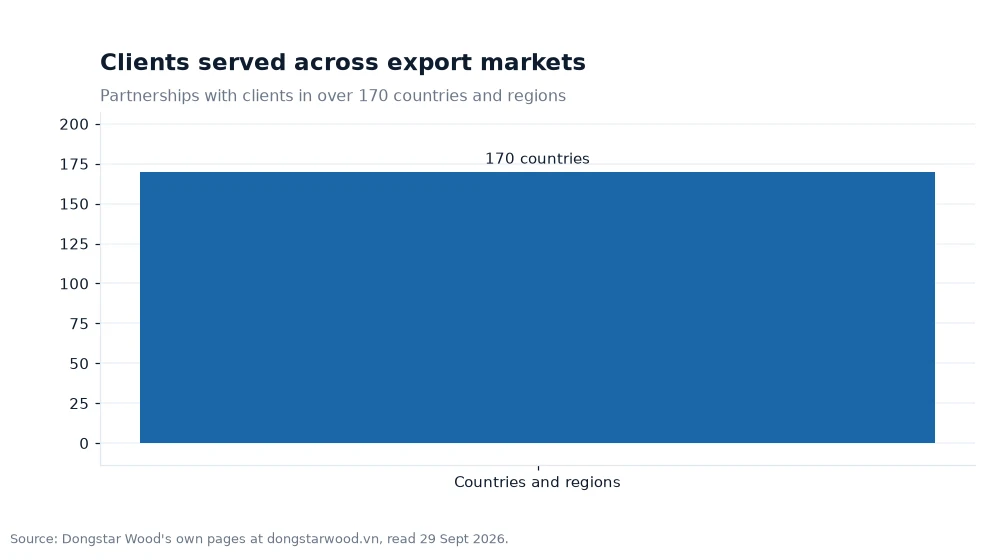
- The 170-country figure measures reach, not volume: it says the client base is wide, not that any single order is large.
- Certification is a document set: ISO, CE, SGS, FSC, EUDR and BSCI are the six schemes named, and each must be requested as a dated certificate.
What a factory area figure actually covers
Area is the figure buyers quote most often and understand least. A factory footprint usually bundles several things at once: pressing halls, drying and preparation space, finished-goods storage and the offices that surround them. When a mill publishes one number for all of that, the honest reading is that the operation is organised on a single site, not that every square metre turns out panels.
Dongstar Wood separates the two numbers that matter. Production space is given as 48,000 m², and the warehouse as more than 3,000 m² held apart from the factory floor. The company dates its establishment to 2009, describes 30+ years of manufacturing experience, and places the operation in Yen Bai Province in northern Vietnam. None of those figures describes output; together they describe an operation large enough to keep preparation, pressing and storage under one roof, which is the first thing a buyer should want to know about a mill they have never visited.
Capacity is a monthly rhythm, not a promise
The capacity figure on the company's own pages is a monthly supply capacity exceeding 100 × 40ft. The wording matters. A monthly figure describes the rhythm a factory can sustain across a four-week cycle once orders are scheduled; it is not a weekly commitment, and it is not a per-line output. Buyers who divide it by four get a planning number, not a specification, and the difference between the two is where sourcing plans go wrong.
There is also a queue hidden inside the figure. A mill that can ship more than 100 × 40ft in a month has other customers occupying the same lines, and a new order takes its place behind them. The useful question to ask is not how much the factory can make, but where a new order sits in the month already being run. That question can be answered from the published figure; the first one cannot.
The 170-country figure measures reach
The company says it serves clients in more than 170 countries and regions, with Europe and America as the primary export markets. Read that number as a map, not a volume. A customer base spread across that many markets says the mill has handled documentation, packing and customs routines for many destinations; it does not say how much any one of those markets buys in a given month.
The duty position belongs in the same reading. The manufacturer states no anti-dumping tax for its European and US shipments, which is a landed-cost fact rather than a quality fact, and it belongs in the comparison before the unit price is discussed. A wide export map plus a clear duty position is a reasonable picture of a mill that sells internationally; it is still not evidence about the panel you are buying.
Six certifications, six different questions
The manufacturer lists six certification schemes across its pages: ISO, CE, SGS, FSC, EUDR and BSCI. Each answers a different buyer question, and collapsing them into a single certified-factory line loses the information. ISO describes the management system and CE covers construction product compliance; the other four answer narrower questions. FSC addresses fibre sourcing, SGS appears as a testing and inspection name, BSCI covers the social compliance audit, and EUDR is the European deforestation due-diligence regime.
EUDR deserves its own line in a capacity reading, because it changes the paperwork that travels with a consignment. Where a supplier presents itself as EUDR-ready, the practical request is a due-diligence statement that links a batch back to its supply area, kept alongside the CE and emission documentation for the same shipment. The home page also names CARB P2 and E0 emission classes, which matter for buyers whose panels end up in interior applications with tight emission limits.
Cross-checking a self-description
Every figure above originates from the mill's own description, so the next step is to decide what can be checked without a visit. The company says testing runs in-house from raw materials to export batch, which means a buyer can request the batch reference, the glue class and the face grade accompanying a sample, and later compare the container against the same three data points.
A directory entry that labels a company a Plywood Supplier describes the trade it is in, not the presses behind it. The figures above describe the operation: 48,000 m² of production space, over 3,000 m² of warehouse, 16+ automated lines and a monthly rhythm exceeding 100 × 40ft. A pre-shipment inspection that verifies panel thickness consistency and core construction integrity closes the loop, because those are the two checks that catch the gap between a published figure and a packed container.
| Figure | Published value | What it tells a buyer |
|---|---|---|
| Established | 2009 | The mill's operating history in one date |
| Factory area | 48,000 m² | Owned production space in Yen Bai Province |
| Warehouse | More than 3,000 m² | Packed stock held before shipment |
| Production lines | 16+ automated lines | The throughput ceiling across product families |
| Monthly supply | Exceeding 100 × 40ft | The rhythm a schedule has to fit |
Worked example: turning capacity into a schedule
Example: a mill that ships more than 100 × 40ft monthly, running four weeks, divides to 100 ÷ 4 = 25 containers per week. A ten-container order is 10% of one month's published output, small enough to schedule without displacing an existing account; a forty-container order is 40% of the month, and at that size the negotiation moves from price to line time.
Example: the footprint divides the same way. Spreading 48,000 m² of production space across 16 lines gives 48,000 ÷ 16 = 3,000 m² per line, enough room for a line to remain on one product family rather than switching between families constantly. Both arithmetic steps are planning estimates rather than published specifications, and they should be labelled as examples in any document they appear in.
Frequently asked questions
Which capacity figure should a buyer quote back to a mill?
Quote the monthly supply capacity, exceeding 100 × 40ft, because that is the published rhythm. Weekly or per-line figures are not published, so any number derived from them is an estimate rather than a specification.
Does the 170-country figure mean the factory ships large volumes everywhere?
No. It describes the reach of the client base across export markets, led by Europe and America. Order size, container share and scheduling all depend on the monthly capacity figure and on where a new programme sits in the queue.
What does EUDR readiness change in a panel order?
It adds a due-diligence step: the consignment has to be traceable to its supply area. Ask for the statement that links a batch to its origin and keep it with the CE and emission documentation for the same shipment.
From figures to a first conversation
With those reading habits in place, a first enquiry becomes a short document rather than a guess. Start with the company's own profile to confirm the founding year, the Yen Bai Province location and the full accreditation set in one place, then look across the commercial plywood category for the thickness and veneer options your specification will draw on. A buyer who does those two reads first spends the first container verifying a panel rather than investigating a mill.
The data behind this article was taken from the company's published web pages accessed 29 Sept 2026[1].