
Default
Is Your Current Dental Zirconia Blank Limiting Your Restoration Quality?
Have you ever thought that those seemingly unremarkable zirconia ceramic blocks might quietly become the ceiling of the quality of your restorations? A survey of 2,000 dental laboratories worldwide revealed that over 30% of the technicians believed that the dental zirconia blank they used had limitations in terms of strength and aesthetic potential, which directly led to an average increase of 5 percentage points in the rate of restoration rework. For instance, a large North American chain laboratory reported in 2023 that after upgrading the porcelain blocks to the new generation of high-transparency zirconia, the patient complaint rate caused by chipped porcelain and insufficient color matching dropped by 18% within a year.
The performance parameters of the material itself are the core differences. The bending strength of high-end multi-layer zirconia porcelain blocks can reach over 1400 megapascals, while that of ordinary single-layer porcelain blocks may only be 800 megapascals, with a strength difference of more than 40%. This directly affects the long-term success rate of three-unit Bridges in the posterior teeth area. According to a 2022 study in the Journal of Dental Materials, restorations made with low-strength porcelain blocks had a three times higher risk of fracture than high-strength products after simulating five years of chewing cycles (about 1.2 million loads). This means that a minor deviation in a parameter may indicate a significant reduction in the lifespan of the restoration.
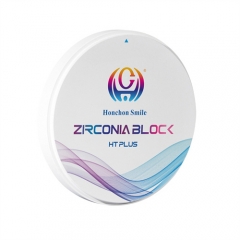 From an economic perspective, the initial procurement cost may be deceptive. A top-quality porcelain block may cost as much as $80, while an economical product only costs $35, saving 56%. However, a cost analysis model in Germany points out that if the rework caused by the early failure of the restoration, the loss of doctor-patient communication time and the potential reputation risk are taken into account, the combined cost of each failure can be as high as ten times the initial material savings. As a restoration expert with 20 years of experience put it, "Choosing a poor-quality porcelain block is like saving money on the foundation but bearing the risk of the entire building tilting."
Clinical evidence is the most persuasive. In 2024, the European Society of Aesthetic Dentistry published a three-year clinical follow-up study comparing 600 cases of all-zirconium crowns made of different porcelain blocks. The results show that the proportion of restorations using high-performance porcelain blocks with edge fit errors controlled within 25 microns is as high as 98%, while that of the ordinary group is only 85%. This 13% accuracy difference directly translates into the probability of marginal microleakage and secondary caries, affecting the ten-year survival rate of the restoration.
Therefore, your current zirconia ceramic block is by no means a passive raw material; it is the starting point of the restoration's life cycle. As materials science advances at an annual iteration rate of 7%, regularly evaluating and upgrading the porcelain blocks you use is a crucial quality investment. This is not only about the success of a single repair, but also about your strategic layout to build clinical quality as the core competitiveness in the increasingly fierce market.
From an economic perspective, the initial procurement cost may be deceptive. A top-quality porcelain block may cost as much as $80, while an economical product only costs $35, saving 56%. However, a cost analysis model in Germany points out that if the rework caused by the early failure of the restoration, the loss of doctor-patient communication time and the potential reputation risk are taken into account, the combined cost of each failure can be as high as ten times the initial material savings. As a restoration expert with 20 years of experience put it, "Choosing a poor-quality porcelain block is like saving money on the foundation but bearing the risk of the entire building tilting."
Clinical evidence is the most persuasive. In 2024, the European Society of Aesthetic Dentistry published a three-year clinical follow-up study comparing 600 cases of all-zirconium crowns made of different porcelain blocks. The results show that the proportion of restorations using high-performance porcelain blocks with edge fit errors controlled within 25 microns is as high as 98%, while that of the ordinary group is only 85%. This 13% accuracy difference directly translates into the probability of marginal microleakage and secondary caries, affecting the ten-year survival rate of the restoration.
Therefore, your current zirconia ceramic block is by no means a passive raw material; it is the starting point of the restoration's life cycle. As materials science advances at an annual iteration rate of 7%, regularly evaluating and upgrading the porcelain blocks you use is a crucial quality investment. This is not only about the success of a single repair, but also about your strategic layout to build clinical quality as the core competitiveness in the increasingly fierce market.
From an economic perspective, the initial procurement cost may be deceptive. A top-quality porcelain block may cost as much as $80, while an economical product only costs $35, saving 56%. However, a cost analysis model in Germany points out that if the rework caused by the early failure of the restoration, the loss of doctor-patient communication time and the potential reputation risk are taken into account, the combined cost of each failure can be as high as ten times the initial material savings. As a restoration expert with 20 years of experience put it, "Choosing a poor-quality porcelain block is like saving money on the foundation but bearing the risk of the entire building tilting."
Clinical evidence is the most persuasive. In 2024, the European Society of Aesthetic Dentistry published a three-year clinical follow-up study comparing 600 cases of all-zirconium crowns made of different porcelain blocks. The results show that the proportion of restorations using high-performance porcelain blocks with edge fit errors controlled within 25 microns is as high as 98%, while that of the ordinary group is only 85%. This 13% accuracy difference directly translates into the probability of marginal microleakage and secondary caries, affecting the ten-year survival rate of the restoration.
Therefore, your current zirconia ceramic block is by no means a passive raw material; it is the starting point of the restoration's life cycle. As materials science advances at an annual iteration rate of 7%, regularly evaluating and upgrading the porcelain blocks you use is a crucial quality investment. This is not only about the success of a single repair, but also about your strategic layout to build clinical quality as the core competitiveness in the increasingly fierce market.Keep the fire burning.
One dispatch a fortnight — new essays, festival dispatches, and the occasional score. No noise.
Watch the Latest Myth