
Five Formula-Ownership Mistakes Haircare Brands Make
Most ownership trouble in haircare is self-inflicted. Brands assume exclusivity is included, skip the reference sample, approve tooling before recording who owns it, treat a supplier-standard base as theirs, and leave the documentation list until the day they want to leave. Each of those is a single mistake with a single fix: one written clause, signed at the right moment. The five mistakes below cover most of the damage a haircare launch can take, and the clause that prevents each one costs almost nothing compared with the dispute it avoids.
Key takeaways
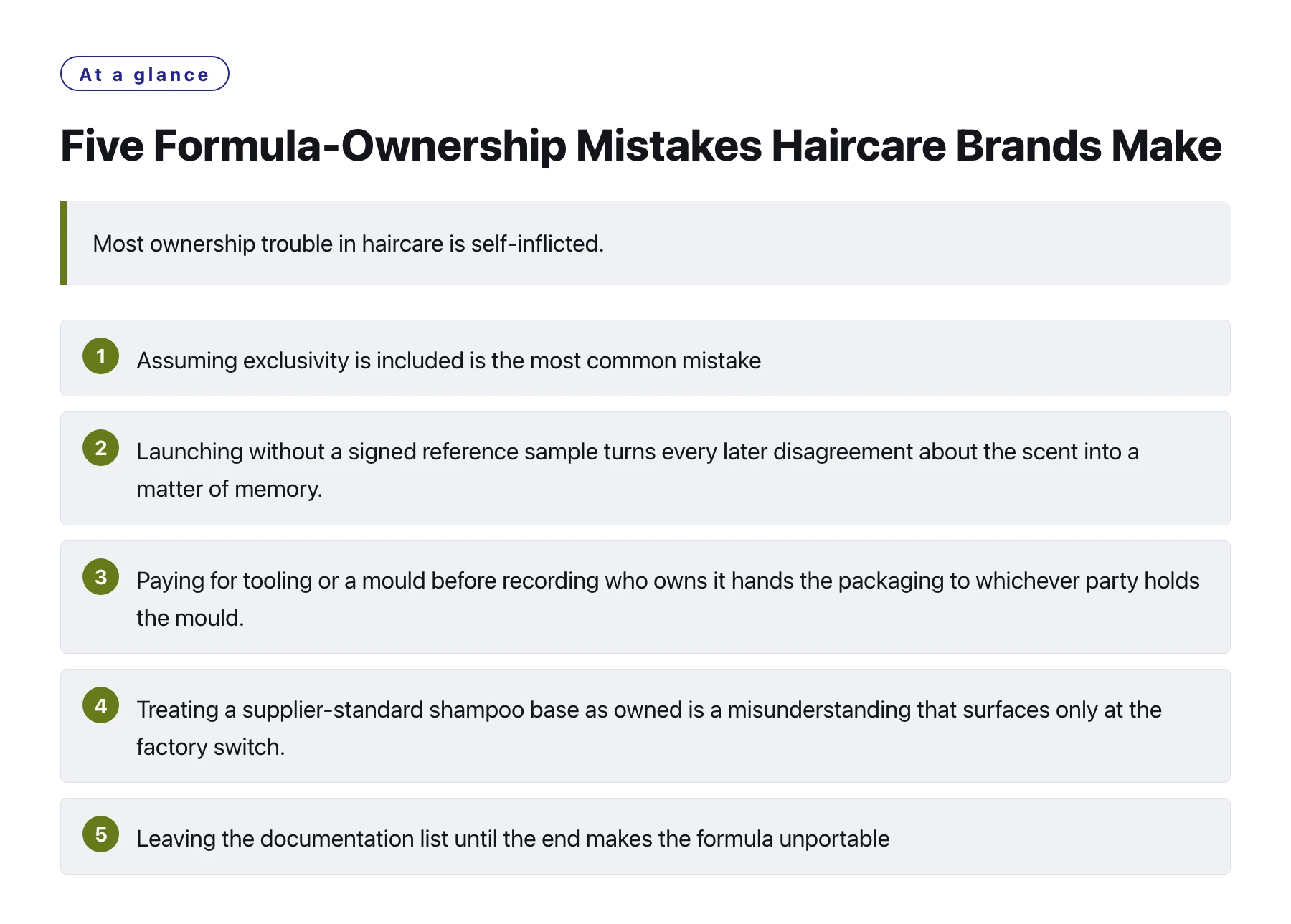
- Assuming exclusivity is included is the most common mistake; exclusivity is a purchased clause with a scope, and it is rarely automatic.
- Launching without a signed reference sample turns every later disagreement about the scent into a matter of memory.
- Paying for tooling or a mould before recording who owns it hands the packaging to whichever party holds the mould.
- Treating a supplier-standard shampoo base as owned is a misunderstanding that surfaces only at the factory switch.
- Leaving the documentation list until the end makes the formula unportable, however clear the ownership clause is.
The pattern in failed ownership discussions is always the same: nobody lied, and nobody wrote anything down. The buyer assumed, the supplier assumed, and the assumption that sounded generous at negotiation sounded expensive at the exit.
This article lists the five mistakes that come up most often when a haircare brand eventually needs to answer for its formula — and, for each one, the clause that would have prevented it.
The five mistakes, and the clause that prevents each
- Mistake one: assuming exclusivity comes with the scentA developed accord may be offered to several clients unless the contract says otherwise. The fix is an exclusivity clause with a scope: which category, which geography, for how long, and at what premium.
- Mistake two: no signed reference samplePhotographs and meeting memories are not a standard. The fix is a sealed physical sample from the approved batch, dated, batch-numbered, signed by both parties and held by each.
- Mistake three: tooling before ownershipThe party that pays for the mould is not automatically the owner. The fix is a tooling agreement signed before the order, stating who owns the mould and what happens to it at the end of the relationship.
- Mistake four: treating the base as ownedA supplier-standard shampoo base is usually the manufacturer's formula, licensed for your order. The fix is a line in the contract stating whether the base transfers, or confirming that a standard base is acceptable to you.
- Mistake five: deferring the documentation listThe batch record, stability file and certificates are what make the formula portable. The fix is a delivery list in the contract, naming each document and the moment at which it transfers.
Why the paper trail is the expensive part
The scent gets the attention and the paper trail gets the blame later. A batch record shows what actually happened on a specific run — raw materials, weights, timings, deviations — and it is the document that lets a second factory reproduce the product or a buyer verify the first [1].
Safety documentation behaves the same way. Fragrance materials carry safe-use limits that depend on the product category and the use level, and a concentrate approved for one form may need a new assessment for another [2]. A brand that collects those statements as it goes avoids the round of re-testing that ambushes launches at the label-approval stage.
The pattern applies to ingredient restrictions as well: finished products sold in the EU are judged against the ingredient rules that apply where the product is placed on the market, which is why the ingredient list should be audited against the official database for the destination market [3].
Clauses worth stealing from bigger buyers
The exclusivity clause
State the scope in four dimensions: the product category (a shampoo-and-conditioner range, not 'all cosmetics'), the geography (one country, a region, or global), the duration (a fixed term, renewable), and the price (a one-off premium or a per-unit fee). Bigger buyers write all four; small brands usually write none.
The transition clause
Describe what happens at the end: which documents transfer, at what cost, within how many days, and whether exclusivity survives the exit for a defined period. A transition clause is what turns a departure from a rebuild into a handover.
The registration clause
Whoever registers the industrial design is the party that can enforce it. The international route administered by WIPO makes multi-country registration a single filing, but only the holder benefits [4] — and the natural holder for a brand's packaging is the brand.
If you fix only one thing before signing, fix the reference sample. Every other clause in this article can be negotiated after samples exist; a product standard cannot be reconstructed from a meeting.
Checking a partner before it is too late
Most of these mistakes are preventable at the vetting stage, and the vetting is easier when the manufacturer publishes substance rather than promises. A company that lists its certifications and its service scope on Xuelei's official website gives you something to check against; a company that describes itself only in meetings gives you nothing.
Context signals help too. A manufacturer that invests in scent culture — Xuelei's scent museum in Guangzhou is the company's own example, described by it as the world's largest — tells you about olfactive ambition, not about contract discipline. Treat it as context, and verify the clauses on paper.
Sources
- SGS: Cosmetics, Personal Care & Household Testing —— Testing, inspection and certification services for cosmetics and personal care, including microbiological, stability and safety testing aligned with cosmetics GMP.
- IFRA: Safe Use and Fragrance Science —— IFRA's explanation of how fragrance materials are scientifically assessed for safe use and how those conclusions are applied by the industry.
- EU CosIng — Cosmetic Ingredient Database (European Commission) —— The European Commission's CosIng database of cosmetic ingredients, listing ingredient functions, restrictions and labelling requirements under EU cosmetics law.
- WIPO — World Intellectual Property Organization —— The UN agency for intellectual property; resources on industrial design and patent protection relevant to product and packaging design.
Frequently asked questions
Is exclusivity ever automatic?
Rarely. Unless the contract says the accord is exclusive to you, assume the starting point may be offered to other clients. Automatic exclusivity is a negotiation outcome, not a default.
Can I fix an ownership gap after samples are approved?
Yes, but it is renegotiation and it is more expensive: once the manufacturer has invested in your direction, the leverage moves. Fixing the gap before sampling costs a clause; fixing it after costs a price.
Who should hold the mould?
The party that wants to reorder the packaging elsewhere. Ownership is recorded in the tooling agreement; whoever holds it controls the reorder. If the brand holds it, a second factory can reproduce the pack.
What does a transition clause look like?
A few lines that name the documents, the transfer cost, the deadline and the surviving exclusivity period. It does not need to be long, only explicit and signed.
Does an NDA protect my brief?
An NDA protects confidentiality; it does not create ownership or exclusivity. Keep the NDA, but do not mistake it for the clauses in this article.
Keep the fire burning.
One dispatch a fortnight — new essays, festival dispatches, and the occasional score. No noise.
Watch the Latest Myth